Jacksonville, FL Office:
Orlando, FL Office:
Tampa, FL Office:

- Home
- Products
- Training & Services
- Manufacturers
- About Us
- Blog
- Contact Us
close
/ By Jason
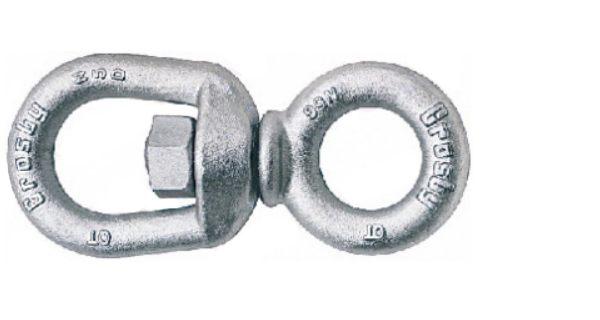
If you take a look at any industry, then chances are, you'll find rigging swivels. Not only does the construction industry use them, but also manufacturing, marine, and the oil and gas industries.
It's such a small piece of equipment that you wouldn't even think twice if you found one on the floor. Yet they're indispensable for site safety. With improper rigging, you risk catastrophic failures, which can have devastating consequences.
So why are these rigging accessories so vital, and how can you choose the right ones for the job? This article will give you all the information you need on rigging swivels so you understand just how important they are.
The main purpose of rigging swivels is to allow for controlled rotation while bearing heavy loads. These are the ways they provide safety in rigging.
While you're lifting a load, forces can cause it to spin, twist, or rotate unexpectedly. As this happens, the rotation travels up through the sling, rope, or wire, and this can cause dangerous coiling or kinking.
A rigging swivel allows the load to rotate independently. As a result, this eliminates torsional stress on your rigging system, and it also prevents equipment damage or failure.
When a load is left to twist uncontrolled, this can damage expensive components, like:
This can also cause premature wear on your crane winches and hoist mechanisms.
However, this can be prevented by introducing a controlled rotation point. Swivels can help extend the life of your entire lifting setup, and this will reduce replacement costs and downtime.
Some loads need careful positioning, such as large panels, modular components, or vessels. An operator can use a rigging swivel to reposition the load mid-air without needing to lower it or manually untwist it.
You'll get:
These are all especially important in confined spaces or if you have delicate equipment.
Most importantly, rigging swivels minimize the risk of dropping loads. With uncontrolled spinning, the hooks or slings can slip, and this causes one of the most dangerous hazards on a worksite.
A simple swivel will help maintain secure, straight-down loading. This reduces side stress and makes drops less likely.
There are several types of swivels, including:
So how can you determine which is right for your lifting equipment?
First, determine the working load limit (WLL). The swivel's WLL will be stamped on it, so make sure your load (including any dynamic forces) is well within it.
Don't forget about shock loads either. Sudden forces can multiply the actual weight on the swivel.
There are three types of loads and movements:
Static lifts are the simplest since all you need are plain-bearing swivels. However, for rotational loads, ball-bearing swivels are safer. As for tilting, multi-angle lifts, swivels with jaw ends give you more flexibility for shackles.
The material you choose will depend on the environment you're using the swivel in. For example, for heavy industrial lifting solutions, you'll want alloy steel. It has high strength, so it's the most common material used.
If you're working in corrosive environments or need rigging swivels for marine purposes, then you'll want stainless steel. It's rust-resistant and requires lower maintenance.
Galvanized steel is the best material for construction and temporary lifting. It's an affordable material and also has a corrosion-resistant coating.
The connection type needs to be matched to your rigging setup. If you're after flexibility, then opt for the jaw and eye swivel, as it's a hybrid type.
Jaw swivels are excellent for modular setups since they're easy to remove. But if you have strong, permanent connections with shackles or hooks, then you're better off with eye swivels.
Lastly, you need to inspect rotational capabilities. You should always confirm whether the rigging swivel rotates under load. This is important for safety, so don't skip this step.
Some cheaper swivels only rotate when unloaded, and this is unsafe for active lifting.
Once you've picked out the optimal rigging swivel, you'll want to know how to use it safely. Here are the steps to take.
Take a look and check the swivel for:
Manually rotate the swivel to see if it spins freely; there should be no grinding or stiffness. Also, inspect the pins and locking mechanisms on jaw-type swivels.
Always load inline (axially). If you load the swivel off-center, then it'll reduce the WLL drastically.
You should also avoid side pulls or angular loading. These can bend or shear the swivel.
You should pair the swivel with correctly sized shackles, hooks, and slings. Don't use it in combination with incompatible materials, such as mixing stainless steel with galvanized (this can cause galvanic corrosion).
Don't shock the load with sudden jerks. And don't modify or repair the swivels without manufacturer authorization.
If your swivel requires maintenance, then use manufacturer-recommended lubricants.
After use, clean the moving parts of debris or dirt. Store the swivel in a dry environment to prevent corrosion.
If you're in a high-risk industry, you should document each use as part of your lift record.
As you can see, rigging swivels are vital to the safety of your worksite. These small yet mighty components can prevent load twisting and reduce stress on your equipment.
So take the time to choose the right swivel type, ensuring that it matches your specific lifting tasks. And never compromise on quality, as your team's safety depends on it.
If you'd like to browse our full catalog of rigging hardware, then contact us today. Southeast Rigging Inc. thoroughly inspects all of our products to make sure that we adhere to all industry standards. We've been in business since 1989.

